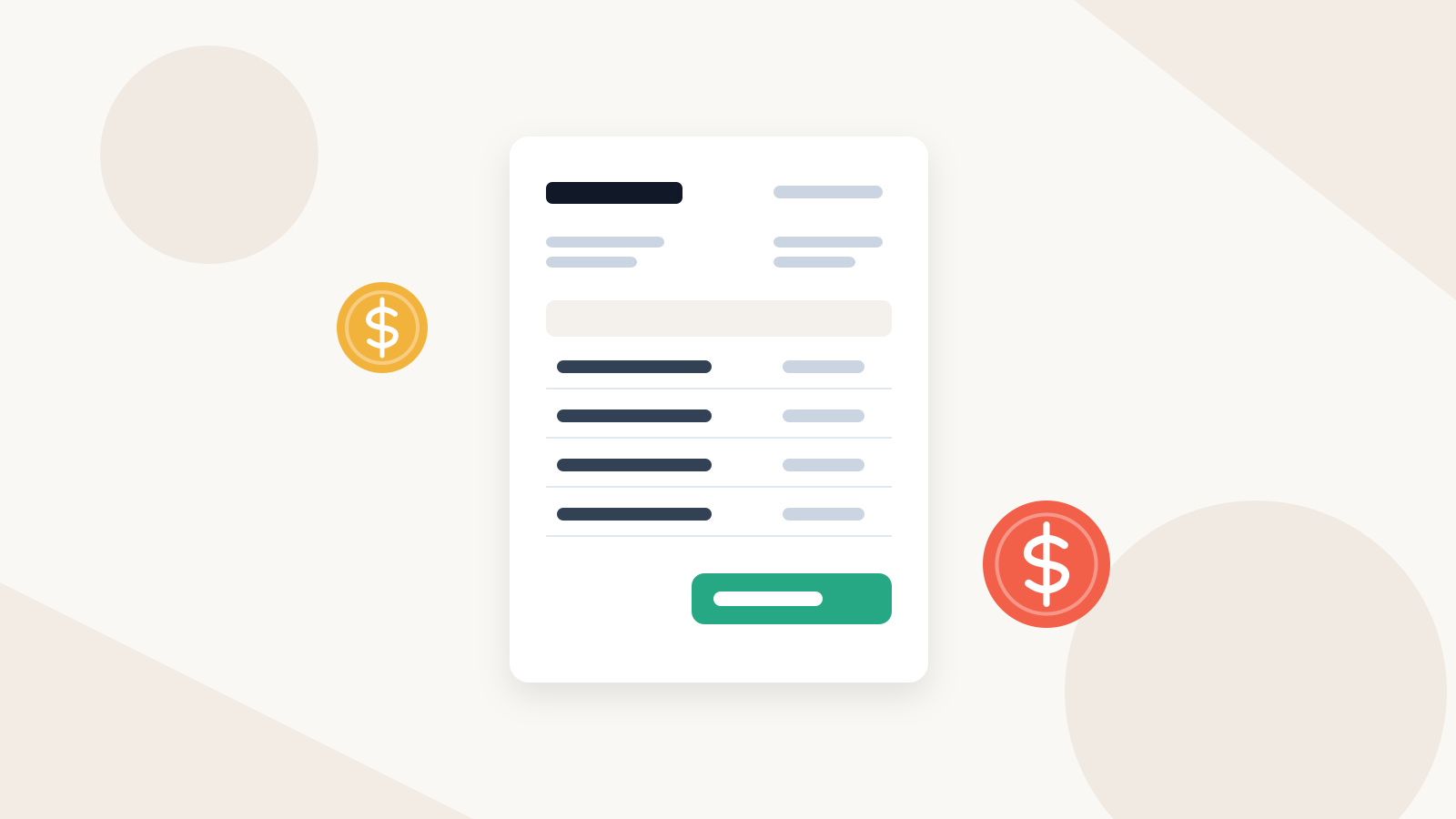
A contractor invoice needs your details and the client's, a unique invoice number, the invoice date, payment terms and due date, one line per piece of work with hours or quantity, rate and amount, the total in one stated currency, and how you will be paid. The free template below lays that out with formulas and opens in Excel and Google Sheets.
Download: contractor invoice template (.xlsx)
It is for contractors and freelancers, many outside the U.S., who bill U.S. clients, and for companies that want every invoice in one format. Companies still working out how to pay people abroad can start with our guide to paying international contractors.
What a contractor invoice must include
The U.S. has no single federal invoice format for contractors, but the IRS lists invoices among the supporting documents a business keeps for income and expenses. Both sides rely on it, so it needs enough detail for someone else to match it to the work and the payment.
| Field | What to write | Why it matters |
|---|---|---|
| From | Your name or business name, address, country, email | Identifies who is being paid |
| Bill to | Client company, contact, address, country, email | Shows who owes the money |
| Invoice number | A unique number from your own sequence | Lets both sides find and match it |
| Invoice date | The day you issue it | Starts the payment terms |
| Payment terms and due date | For example 15 days, due Dec 1 | Sets when payment is expected |
| Work period | The dates the work covers | Ties hours to the right weeks |
| Line items | Description, type, hours or quantity, unit, rate, amount | Shows how the total was reached |
| Subtotal, tax, total | Calculated totals | The amount to be paid |
| Currency | One currency for the whole invoice | Prevents mixed-currency errors |
| Payment details | Method and account name, no full account numbers | Tells the client how to pay without exposing your details |
| Contract or PO reference | Agreement name or PO number, if any | Links the invoice to the agreed rates |
Your own country may set stricter rules. In the European Union, for example, a full VAT invoice must carry a unique sequential number, both parties' names and addresses, a description and quantity of the services and the unit price, among other items, and an invoice where the customer accounts for the VAT must say "reverse charge" (European Commission). Freelancers registered in other countries, such as the Philippines, should check their local tax authority's invoicing rules; our guide to paying contractors in the Philippines covers the payment side.
An invoice is not a tax form: U.S. clients ask separately for a W-9 or W-8BEN (see W-8BEN vs W-9 for contractors).
What is in the template
The file has four tabs. White boxed cells are where you type; gray cells are formulas.
- How to use. Ten short steps and a legend.
- Invoice. A blank, print-ready invoice: From and Bill to blocks, Invoice details (number, date, payment terms, due date, work period, currency), ten line items, totals, payment details and notes.
- Example invoice. The same invoice completed with fictional data, described in the worked example below.
- Invoice log. One row per invoice you send: number, client, dates, currency, amount, status (Sent, Paid, Cancelled), paid date, payment reference and a days-overdue count.
The formulas: Due date is the invoice date plus the payment terms in days. Each line's Amount is hours or quantity x rate, rounded to cents. Total due is the subtotal plus tax (0% by default) minus any deposit already paid, shown with your currency code. Payment reference repeats the invoice number for the client to put on the transfer, and the log's Days overdue counts from the due date until you enter a paid date. Type, Unit and Payment method are drop-down lists, so every invoice uses the same words.
How to write hourly, fixed and milestone lines
Most contractor invoices mix line types. Write each one so the client can check it against the contract without asking you.
| Line type | Hours / qty and unit | Rate | Description should say |
|---|---|---|---|
| Hourly | Approved hours, for example 42.5 hours | Hourly rate | Project and the dates covered, and that the hours match the approved timesheet |
| Fixed (retainer) | 1 month | Monthly fee | What the retainer covers and which month |
| Fixed (project) | 1 item | Agreed fee | The deliverable |
| Milestone | 1 milestone | Agreed milestone amount | Which milestone (2 of 3), what was delivered, and when it was accepted |
| Expense | 1 item | Cost | What it was, that the client agreed to it, and that a receipt is attached |
Hourly lines should use the hours your client approved, not a fresh count; our weekly timesheet template produces those weekly totals. Write hours as decimals: 42 hours 30 minutes is 42.50, not 42.30.
Currency and payment details
One currency per invoice. Bill in the currency your contract names and keep every line in it. If your contract is in U.S. dollars and you live in the Philippines, the invoice is in USD; conversion to pesos happens at your provider or bank, not on the invoice.
Name the method, not the numbers. The payment block asks for the method (Wise, Payoneer, PayPal, bank transfer), the name on the account and the receiving currency. Invoices get forwarded and stored in shared folders, so leave full account numbers off: give them to the client once through a secure channel and write "On file with the client".
Confirm changes outside the invoice. If your account changes, tell the client separately so they can confirm it with you through a contact they already trust. Companies should never pay new account details that arrived only on an invoice or an email reply.
Fees. Who covers transfer fees is something to agree in the contract. The invoice shows the amount due; the provider's fee is set by the provider.
Invoice numbering
- Unique. Never reuse a number, even for a cancelled invoice.
- Sequential. Count up without gaps, so a missing number stands out (some countries require it).
- Readable. MS-2026-014 is Maria Santos's 14th invoice of 2026.
- Corrected, not edited. Fix a sent invoice with a credit note or a new invoice that refers to the old number, and mark the old one Cancelled on the log.
How to fill in and send the invoice
- Copy the Invoice tab, then fill in From, Bill to and Invoice details with the next number from your log.
- Add one line per piece of work, leave Tax at 0% unless your tax rules require it, and check Total due.
- Delete the "Template from RemiPay" line and send a PDF, not the spreadsheet.
- Record the invoice on the log and mark it Paid when the money arrives.
Worked example: a fictional designer's invoice
The Example invoice tab is a fictional sample. Maria Santos, an invented freelance designer in Cebu, Philippines, invoices Harbor & Pine Studio, an invented U.S. agency, for the first half of November 2026. All names and amounts are illustrative.
Invoice MS-2026-014 is dated November 16, 2026, on 15-day terms, so the formula sets the due date to December 1, 2026. The currency is USD.
| Description | Type | Hours / qty | Rate | Amount |
|---|---|---|---|---|
| Web design, Brightline website (Nov 1 to 15, per approved timesheets) | Hourly | 42.50 hours | 25.00 | 1,062.50 |
| Monthly retainer: social media templates (November) | Fixed | 1 month | 600.00 | 600.00 |
| Milestone 2 of 3: Oakfield app icon set, delivered Nov 12 | Milestone | 1 milestone | 450.00 | 450.00 |
| Stock image license, pre-approved by client (receipt attached) | Expense | 1 item | 35.00 | 35.00 |
| Total due (USD) | 2,147.50 |
Tax is 0% and no deposit was paid, so Total due equals the subtotal. The payment block names Wise, Maria Santos as account name and USD as receiving currency, with account details "On file with Harbor & Pine Studio".
The studio's owner checks the hourly line against the two approved timesheets, confirms milestone 2 was accepted, pays $2,147.50 from the studio's Wise Business account with MS-2026-014 as the reference, and files the invoice with the payment. Maria marks it Paid on her log.
When the client's system replaces invoices
For a company paying several contractors every month, chasing invoices is slow, and hourly lines only repeat the approved timesheets. Many teams switch to a recurring pay run built from approved hours, retainers and milestones, and treat invoices as optional.
That is how RemiPay works. Contractors record time with the RemiStaff timer, a weekly timesheet or a Hubstaff sync, and the client reviews the hours by client and project (hand-typed hours always wait for the client's approval). RemiPay prepares the pay run from approved hours, fixed amounts and milestones, and the owner approves it. The owner then pays each contractor from their own Wise Business account, Payoneer, PayPal or bank and marks each payment paid in RemiPay, optionally with the transfer reference. The money never passes through RemiPay.
Contractors who still issue invoices (for their own books or local rules) are covered: each payment has an invoice-number column, so their number sits beside the payment in the bookkeeper's export. Contractors see each payment's status in their portal and do not pay for RemiPay; see RemiPay for contractors. Companies pay a flat subscription: Solo $19/month for up to 3 contractors, Starter $49 for up to 10, Team $199 for up to 50 (pricing). Transfer fees are the provider's.
Common questions
Do independent contractors have to send invoices? It depends on the contract and on the contractor's own tax rules. Many U.S. clients ask for an invoice before paying, while others pay from approved hours or milestones on a recurring pay run and only need the contractor's invoice number, if any, for their records. Some countries require contractors to issue invoices in a set format.
What should a freelance invoice include? Your name and contact details, the client's name and address, a unique invoice number, the invoice date, payment terms and due date, a line for each piece of work with hours or quantity, rate and amount, the total and its currency, and the payment method you will use.
Can I invoice a U.S. client in U.S. dollars from another country? Yes, if that is the currency in your contract. State the currency on the invoice and keep every line in it. Conversion to your local currency happens at your payment provider or bank, not on the invoice.
Should I put my bank details on an invoice? Name the payment method, such as Wise, Payoneer, PayPal or bank transfer, but avoid full account numbers. Give your account details to the client once through a secure channel, and when they change, tell the client separately so they can confirm the change with you directly.
This page is general information, not tax or legal advice; check your own country's invoicing and tax rules.
Sources
- IRS, What kind of records should I keep (page last reviewed August 3, 2026): https://www.irs.gov/businesses/small-businesses-self-employed/what-kind-of-records-should-i-keep
- European Commission, VAT invoicing rules: https://taxation-customs.ec.europa.eu/taxation/vat/vat-businesses/vat-invoicing_en
- Google Docs Editors Help, Work with Office files: https://support.google.com/docs/answer/6055139?hl=en
Checked November 16, 2026
Next steps
- Download the contractor invoice template (.xlsx) and copy the Invoice tab for your next invoice.
- Track the hours behind your hourly lines with the weekly timesheet template.
- Paying contractors abroad? Read how to pay international contractors.
- Replace hourly invoices with a pay run from approved hours: see RemiPay pricing or how it looks for contractors.
Posts from the RemiPay editorial team. Have a question or topic request? Email hello@remipay.co.